
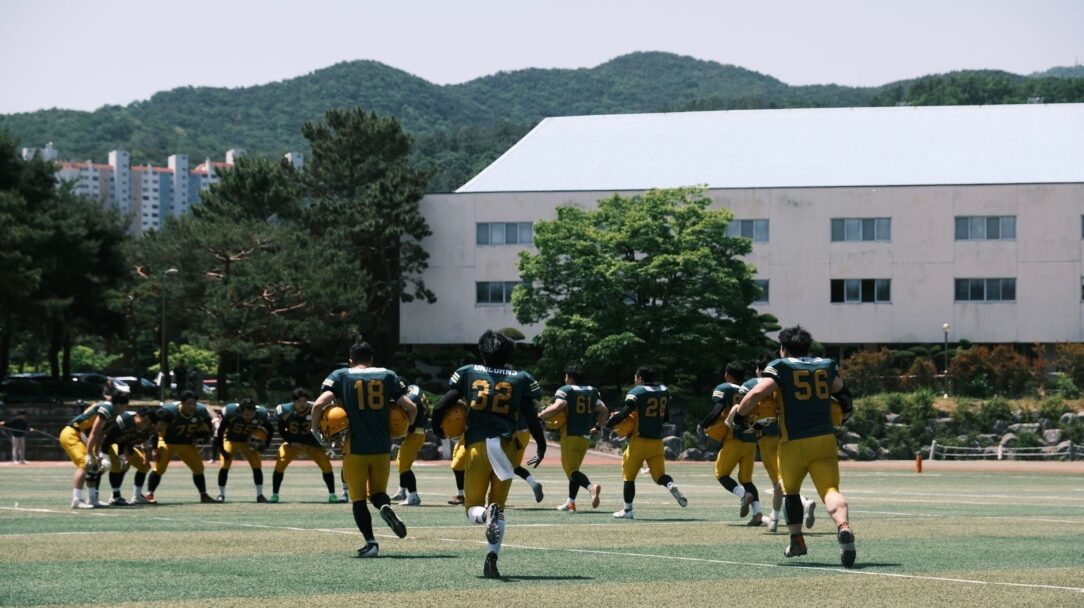
The Silent Crucible Beneath Saturday Stadium Lights
Saturday afternoon sells college football as spectacle. Bands push the noise into the upper deck, recruiting visitors watch warmups from the sideline, and the starters emerge beneath a wall of cameras and expectation. A redshirt freshman often experiences the same day from sweatpants, a headset, or the far edge of the bench, close enough to hear the collision but not yet trusted to enter it. That distance can look like inactivity to a casual observer. Inside a serious program, it is anything but.
Redshirt status is commonly understood as a way to preserve a season of competition, but the practical meaning is much broader. A player can practice, study the playbook, receive a scholarship, lift, travel in some circumstances, and contribute to preparation without appearing in ordinary game action. The governing framework can change by division and over time, so recruits and families should verify the details with a school compliance office. A useful Authoritative Source explaining how redshirt rules work provides the starting point, but eligibility decisions remain institution-specific.
The redshirt year is college football’s developmental furnace. It remodels a teenage body for Division I collisions, forces a celebrated recruit to compete without public validation, and teaches a player to prepare like a professional before receiving professional visibility. That challenge is sharper in the current era, when NIL opportunities, social media attention, and the transfer portal can make patience feel outdated. The central question is no longer whether a player can wait. It is whether the player can turn waiting into an advantage.
Iron and Calories Building the Division One Frame
The first transformation is usually visible in the weight room and dining hall. Many incoming players arrive with impressive high school production but bodies that have not yet adapted to the length, leverage, and force of college football. A staff may target an additional 20 to 30 pounds over several seasons, but the goal is not simply a larger number on a scale. The added mass must be useful, stable, and compatible with acceleration, balance, flexibility, and repeated contact.
North Dakota State’s development of tight end Josh Babicz illustrates the daily demands. At 6 feet 6 inches and approximately 220 pounds entering fall camp, he was expected to move toward 250 pounds. By mid-September, he had reached 238 pounds through frequent eating, often four or five substantial meals or eating occasions each day. Two or three plates at a meal, milk, yogurt, desserts, sandwiches, and shakes can sound simple. Sustaining that intake while attending class, practicing, lifting, and recovering is a job in itself.
Strength work provides the other half of the equation. Olympic lift variations, squats, presses, pulls, sprint work, and position-specific movement patterns are organized to develop force without sacrificing movement quality. At NC State, defensive lineman Colby Cronk reportedly improved his power clean from 365 pounds after high school to 385 pounds during the developmental program and eventually to a program-record 410 pounds. His body weight rose from roughly 260 to 265 pounds toward 285 to 288 pounds, giving him the potential to function across multiple defensive-line positions. The power clean matters because hip drive and explosive extension resemble the first violent moments of a pass rush or run fit.

Those numbers are examples, not universal benchmarks. A developmental staff will account for position, frame, training age, injury history, and the athlete’s ability to retain speed. Aggressive weight gain creates risk if it reduces ankle mobility, hip rotation, conditioning, or joint control. The best programs use athletic trainers, nutrition staff, strength coaches, and position coaches together, monitoring movement and recovery rather than celebrating every pound.
| Development area | Incoming challenge | Post-redshirt target |
|---|---|---|
| Body composition | High school frame may lack functional mass | More position-appropriate lean tissue without unnecessary fatigue |
| Explosive strength | Power production is inconsistent under college loads | Improved force, hip drive, and contact balance |
| Movement quality | Weight gain can threaten speed and flexibility | Size maintained alongside acceleration, mobility, and change of direction |
| Recovery habits | Teenage routines may be irregular | Structured sleep, fueling, treatment, and workload management |
The clearest takeaway is that the redshirt year does not merely make an athlete bigger. It teaches the athlete to manage a body that has become a daily competitive responsibility. For an SEC offensive lineman, linebacker, or edge rusher, that foundation can determine whether sophomore snaps become functional football or survival mode.
Scout Team Warfare and the Ego Reduction Machine
Tuesday is where the romance of recruiting stars meets the blunt reality of roster hierarchy. The redshirt freshman may spend practice running the opponent’s offense, aligning with a card, and repeating the same concepts until the scout-team look is accurate. Across the ball, starting defenders are not treating that work as a rehearsal. They are competing, striking, chasing, and demanding that the scout offense create credible stress before the weekend.
For a four-star recruit who was a hometown legend months earlier, the psychological adjustment can be severe. High school status disappears quickly when the depth chart places that player behind older, stronger, more trusted teammates. The athlete may be valuable to the game plan while remaining invisible to the public. That contradiction produces an identity crisis: the player is still talented, but the evidence that once confirmed that identity, touchdowns, tackles, headlines, and offers, has temporarily vanished.
A Division II study of redshirt football players found recurring themes of prior high school distinction, determination, isolation, and limited desire for close team relationships. Its title, “You Never Saw the Light at the End of the Tunnel”, captures the danger of an unclear developmental promise. If coaches say only “keep working” without explaining the pathway, a player can interpret patience as permanent exclusion. That is not softness. It is a predictable response to uncertainty, public comparison, and restricted control.
Coaches can attack the problem without lowering standards. Scout-team awards, private film recognition, position-room teaching roles, and specific feedback can show that preparation has consequences even when it does not produce statistics. A redshirt receiver who consistently wins against the starting corner in practice may not enter the game, but that performance can alter how the staff evaluates the matchup and how the defense prepares. Recognition must be precise, not ceremonial.
- Define the technical skills the player must master before earning snaps.
- Explain the roster timeline honestly, including position competition and likely points of opportunity.
- Use scout-team performance as a measurable evaluation category, not background noise.
- Build social integration through veteran mentorship, position meetings, and shared leadership tasks.
- Provide a clear contact point for mental-health and academic support before isolation becomes a crisis.
The scout team is an ego reduction machine, but it should not be a dignity reduction machine. The difference separates a demanding developmental culture from a careless one.
Mental Performance and Navigating the Tunnel
Elite athletic departments increasingly treat mental performance as part of preparation rather than an emergency service. Sports psychologists, counselors, mental-performance coaches, athletic trainers, and peer advocates can help athletes separate playing time from personal value. That distinction matters most when the weekly routine offers little public reward. A player must learn to measure execution, preparation, communication, recovery, and response to coaching, not simply the number beside a name on the stat sheet.
Boise State’s BroncoBOLD initiative offers one example of a broader campus approach. The student-athlete-led program emphasizes awareness, reduced stigma, and resilience while addressing competition, academics, injury, distance from home, and isolation. Its model reflects a practical truth for redshirts: support works best when athletes know where to find it and see trusted teammates treating help-seeking as normal.
A disciplined weekly routine can make the tunnel navigable. The exact schedule differs by program, but the principles are consistent.
- Set two or three controllable football objectives for each practice, such as alignment, hand placement, or communication.
- Review film for evidence of improvement, not only mistakes that threaten the depth chart.
- Keep a recovery log covering sleep, nutrition, soreness, treatment, and emotional readiness.
- Schedule regular conversations with a position coach, mentor, or sports psychologist.
- Maintain academic and personal interests that protect identity beyond football without weakening football commitment.
The professional standard is preparation before recognition. A redshirt who learns to perform that standard consistently has already gained a skill that follows every roster move, coaching change, injury setback, and contract negotiation.
Developmental Patience in the Era of the Transfer Portal
The transfer portal has changed roster construction, but it has not changed the biological timetable of strength, technical learning, or emotional maturity. A coach may need an immediate starter at cornerback or guard, while the long-term plan calls for developing a freshman over two or three seasons. The tension is structural. One side of the roster is judged by Saturday’s result; the other is built through repetitions that may not pay off until a later season.
Programs that consistently produce NFL draft capital tend to treat development as a system rather than a slogan. North Dakota State’s nutrition and strength approach shows how daily infrastructure can turn a raw frame into a position-ready body. NC State’s handling of Cronk illustrates how strength gains, versatility, reliability, and team behavior can combine into a broader evaluation. At powerhouse programs across the SEC and nationally, the same principle appears in different forms: the sophomore breakout usually begins with untelevised work against starters, special-teams preparation, and a year of learning how the scheme actually functions under pressure.
The modern redshirt rules also give coaches more tactical flexibility. Under the current four-game redshirt provision for eligible players, an athlete may appear in limited competition and still preserve the season, subject to the applicable governing rules and individual circumstances. That can provide valuable live-game experience, emergency depth, or a controlled introduction to college speed. It can also complicate morale if players believe appearances are being used inconsistently or if the distinction between development and immediate contribution is poorly explained.
- Use limited game appearances to answer a specific developmental question.
- Protect the season when the player is not ready for sustained competition.
- Explain the decision clearly to the athlete and, when appropriate, the family.
- Revisit the plan after injuries, depth-chart changes, or significant performance gains.
- Pair eligibility management with a credible academic and football development timeline.
Portal culture rewards movement when a situation no longer fits, and sometimes transferring is the correct decision. But leaving before the body, technique, and support network develop can trade a difficult season for a different form of uncertainty. The smartest roster decisions are not automatically the fastest ones.
How Sufferers on the Sideline Become Tomorrow Game Day Masters
The redshirt year compounds advantages that are easy to miss on a broadcast. The player may become stronger without losing speed, more fluent in the playbook, more reliable in recovery, and more emotionally stable when a coach corrects a mistake. Practice against established starters creates a private laboratory for technique. Film study reveals tendencies before the player must diagnose them at full game speed. The sideline view, properly used, becomes an education in spacing, tempo, communication, and situational football.
That is why sophomore breakouts deserve a deeper lens. The sudden impact did not begin when the player finally entered the stadium. It began when eating enough became routine, when a power clean stalled and had to be rebuilt, when a scout-team rep ended with no applause, and when preparation continued despite uncertainty. In an era built around immediate attention, the most durable competitive edge may still be patience with a plan. The athlete who survives the shadows does not merely wait for game day. That athlete arrives prepared to own it.