
When September Defined the Entire College Football Universe: The SEC East Divisional Rivalry
In 1992, the SEC’s divisional realignment did more than reorganize a conference map. It created an annual SEC East divisional rivalry between Florida and Tennessee, two programs with national ambitions, distinct football identities, and no interest in easing into the season. Competing within the newly formed Eastern Division made the matchup unavoidable, and the timing made it combustible. September was no longer a warm-up period. It became a referendum on which program controlled the division, the conference, and often the national championship conversation.
The rivalry’s importance came from more than proximity or tradition. Florida and Tennessee repeatedly entered the season ranked, stocked with NFL-caliber talent, and positioned to make a championship run. A loss in the early-season showdown did not always eliminate a team from contention, but it created an immediate climb through the standings and sharpened every later mistake. The winner gained the division’s inside track and, just as importantly, the public authority to claim that its style represented the future of SEC football.
That argument was embodied by the coaches. Steve Spurrier treated the forward pass as both weapon and declaration of independence from old SEC orthodoxy. Phillip Fulmer answered with structure, toughness, and a pro-style offense designed to make every yard feel earned. Spurrier wanted to stretch the field before a defense could settle. Fulmer wanted to control the line, punish hesitation, and force opponents to survive a full four-quarter examination. Their rivalry was a tactical contest, but it was also a clash between football cultures.
A Tactical Revolution Against Power Football Tradition
Spurrier’s Florida offense challenged the conference’s prevailing assumptions. The Gators were willing to throw on early downs, attack one-on-one coverage, and use formation variation to create hesitation before the snap. The passing game was not an emergency response to a stalled running attack. It was the organizing principle. Quarterbacks such as Danny Wuerffel operated with anticipation, rhythm, and the freedom to exploit favorable matchups before Tennessee’s pressure package could arrive.
The most important change was psychological. Florida made defensive coordinators defend the entire width of the field immediately. A cornerback could not simply crowd a receiver without risking a vertical shot. A linebacker stepping toward the run could open a passing lane behind him. Spurrier’s offense converted tempo and spacing into stress, then used that stress to create explosive plays. The approach helped redefine what SEC offensive ambition could look like, especially on a stage where conservative football had long been treated as a virtue.
Fulmer’s response was not a simplistic attempt to outscore Florida with the same tools. Tennessee used pro-style precision, multiple formations, play-action concepts, and power counters that punished defenses for overcommitting. The Volunteers wanted their offensive line and backfield to establish control, then let the passing game attack the consequences. On defense, the front seven carried the identity. Gap discipline, physical tackling, and pressure from a deep front made every Florida possession a test of timing and patience.
| Category | Florida under Spurrier | Tennessee under Fulmer |
|---|---|---|
| Offensive identity | Pass-first spread concepts, timing routes, aggressive downfield throws | Pro-style balance, power runs, counters, and play action |
| Preferred pace | Fast rhythm designed to expose coverage before substitutions | Controlled tempo designed to dictate personnel and field position |
| Primary stress point | Defensive communication and coverage leverage | Blocking assignments, tackling, and fourth-quarter durability |
| Defensive philosophy | Pressure and disruption to create possessions for the offense | Front-seven control, physicality, and disciplined pursuit |
The contrast made the rivalry unusually legible. Florida sought the matchup that could break open the game in a single series. Tennessee sought the accumulation of advantages: a successful run on second down, a clean pocket on third down, a defensive stop near midfield, and a field-position edge that eventually tightened the opponent’s options. The official series histories show how long the rivalry has endured, beginning in 1916, while the 1990s transformed it into a central SEC event. A useful starting point for the broader record and historical context is this rivalry history overview.
Psychological Warfare and the Art of the Needle
Spurrier understood that a rivalry is played in the press conference as much as on the field. His jokes and barbs, including digs associated with Tennessee’s postseason disappointments and recruiting battles, were not random entertainment. They kept Florida’s offense and personality in the national conversation, while placing pressure on Tennessee to prove that physical control could overcome Florida’s speed and confidence. A well-timed line could turn a routine September game into a referendum on program identity.
Fulmer rarely answered in the same register. His public demeanor was measured, but that restraint should not be confused with passivity. Tennessee’s locker room carried a fierce internal standard, built around preparation, toughness, and the conviction that Florida’s flash could be blunted by disciplined football. The contrast intensified recruiting. Prospects in Florida, Georgia, and Tennessee were not merely choosing a depth chart. They were choosing between two visions of college football, one built around creative offensive freedom and the other around professional structure and physical development.
- Florida sold immediate responsibility in a high-volume passing attack and the visibility that came with Spurrier’s national profile.
- Tennessee emphasized line play, positional development, balance, and a pathway built on sustained physicality.
- Each rivalry game became a recruiting exhibit, with every explosive play or goal-line stand serving as evidence for one program’s philosophy.
That recruiting competition mattered because the rivalry was never isolated to the two campuses. Florida could draw from a deep in-state talent pool, while Tennessee fought to remain a destination for elite players across the Southeast. Georgia’s location between the programs made the region especially valuable. A prospect could see the rivalry as a direct comparison of coaching, development, exposure, and postseason opportunity, making the annual game part of the recruiting calendar even when no verbal commitment was at stake.
The Stadium Crucible from Knoxville to Gainesville
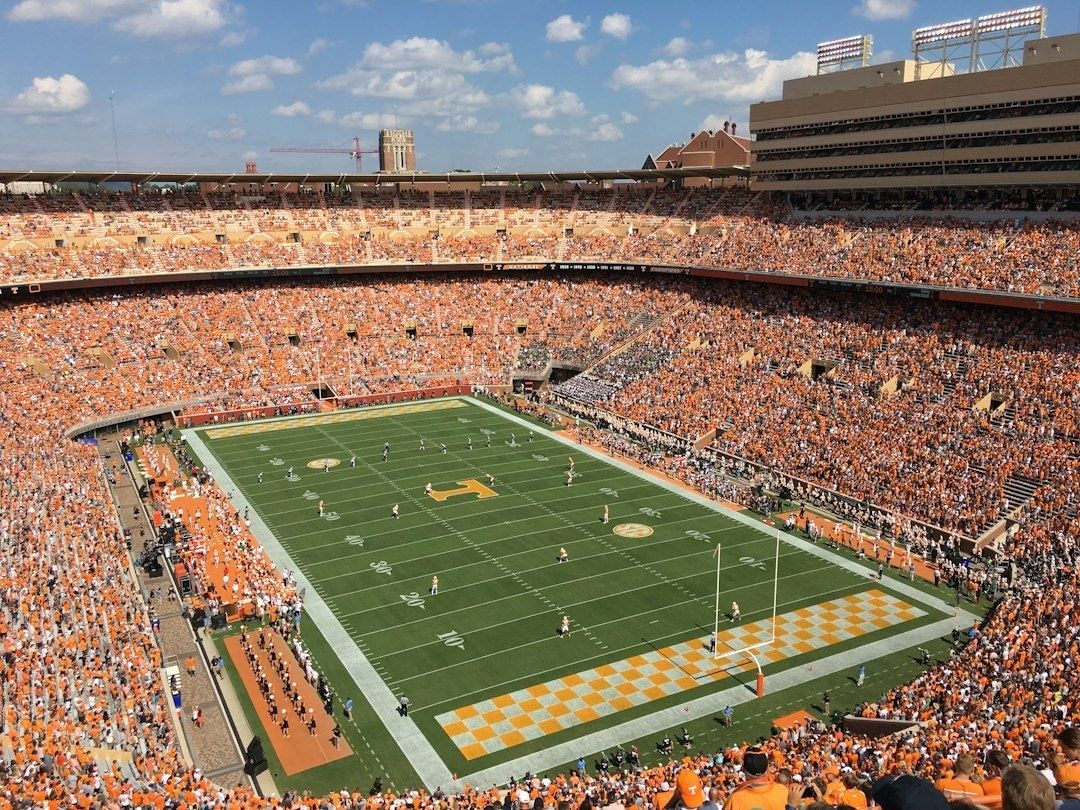
Neyland Stadium and Ben Hill Griffin Stadium created different forms of pressure. Knoxville offered an immense, rising roar that could accelerate Tennessee’s defensive front and make communication difficult for an opposing offense. Gainesville brought heat, humidity, and an atmosphere that could feel physically draining before the fourth quarter arrived. The stadiums did not merely host the rivalry. They shaped how it was experienced, with noise and climate becoming part of the tactical equation.
Quarterbacks carried the rivalry’s most visible burden. Peyton Manning’s pursuit of a defining victory over Florida became one of the decade’s central narratives, because Tennessee’s broader excellence was repeatedly measured against the Gators. On the other side, Wuerffel’s poise represented Spurrier’s ideal quarterback: calm in the pocket, willing to challenge tight windows, and capable of treating pressure as information rather than panic. Their contrasting arcs gave the rivalry a human center beyond scheme diagrams.
The larger lesson is that Southern rivalries gain power from borders that are both geographic and cultural. Florida and Tennessee represented different regional traditions, recruiting ecosystems, and assumptions about how football should be played. That same intensity can be seen in the historical relationship between Florida A&M and Tennessee State, a matchup whose meaning reaches beyond the scoreboard and into HBCU culture. The documented history of that rivalry, including its connection to championship traditions and African American communities, is explored in this account of the FAMU and Tennessee State rivalry.
Those cultural dimensions help explain why a Florida-Tennessee game could feel larger than a conference contest. The matchup carried state pride, coaching pride, recruiting consequences, and national implications into one afternoon. Every third down seemed to ask which tradition would survive the pressure. Every late possession had the weight of a season that might otherwise remain months away.
Turning Points That Shaped Modern College Football
The September 16, 1995 meeting in Gainesville became the ultimate validation of Spurrier’s offensive revolution. While the 1992 matchup in Knoxville had been the iconic “Monsoon Game”-where a torrential deluge knocked out television broadcasts and Tennessee leaned on a punishing ground game to win 31-14-the 1995 clash in The Swamp was a record-shattering aerial clinic. Tennessee surged to an early 30-14 lead behind Peyton Manning, only for Florida’s “Fun ‘n’ Gun” to unleash 48 unanswered points in a 62-37 rout. Danny Wuerffel fired six touchdown passes, Manning threw for 326 yards, and the two SEC East powers combined for 99 points and over 1,000 yards of total offense, proving that Florida’s vertical passing game could dismantle even elite, top-ten defenses.
The 1998 overtime thriller in Knoxville offered a different kind of pressure. Instead of an offensive runaway, the contest compressed national expectation into a sequence of high-leverage possessions. Overtime removed the comfort of a long game plan and forced execution near the goal line, where protection, route precision, tackling, and decision-making were exposed. Tennessee’s ability to win that kind of tense exchange reinforced the program’s belief that structure and physical resilience could withstand Florida’s offensive imagination.
The direct line from the September showdown to the national championship trophy became one of the decade’s strongest storylines. Florida’s 1996 national championship season gave the Gators the ultimate proof of concept, while Tennessee’s later championship run showed that the Volunteers’ patient, punishing model could reach the same summit. The annual game did not mathematically decide every championship race, but it often established the hierarchy from which the rest of the season unfolded.
- The 1995 Gainesville shootout stands out as the ultimate showcase of the “Fun ‘n’ Gun,” where Florida erased a 30-14 deficit with 48 unanswered points to win 62-37 in a 99-point offensive explosion.
- The 1996 Florida breakthrough carried special weight because it connected Spurrier’s offensive revolution to the program’s first recognized national championship.
- The 1998 Knoxville overtime thriller demonstrated that the rivalry had evolved into a national event where one late possession could define an entire season.
- The repeated September stakes made Florida and Tennessee an annual national checkpoint, forcing both programs to reveal their championship level before conference races had fully developed.
The available official series records place the rivalry in a much longer historical frame, but the 1990s remain the era that changed its national meaning. Tennessee’s historical documentation lists the 45-3 result in 1990 as the largest Volunteers margin in the series, while Florida’s record emphasizes the Gators’ later dominance across much of the modern matchup. Those figures matter less than the competitive transformation: the rivalry became a recurring collision of ranked teams, elite quarterbacks, and championship-caliber staffs.
The Enduring Blueprint of Southern Gridiron Dominance
The Florida-Tennessee rivalry helped establish the template for the modern SEC television product. It offered recognizable coaches, contrasting systems, elite players, verbal sparring, hostile venues, and immediate postseason consequences. That combination was ideal for a conference increasingly built around national windows and high-stakes branding. The appeal was not manufactured after the fact. It was visible in the way September audiences treated the game as a national checkpoint.
Spurrier and Fulmer also earned a form of respect that only sustained competition can produce. Their programs attacked each other through scheme, recruiting, preparation, and public pressure, yet the rivalry’s credibility came from the fact that neither side could dismiss the other. Florida’s innovation required Tennessee’s physical answer. Tennessee’s structure required Florida’s precision. Blood, noise, weather, and late-game pressure turned those differences into a shared standard.
Every later September meeting inherits that foundation. The uniforms and rosters change, and the conference landscape continues to evolve, but the central question remains familiar: can creativity break disciplined force, or can disciplined force contain creativity? That is why the rivalry still carries an echo from the 1990s. The decade did not merely produce memorable games. It taught college football how an annual conference matchup could become a national event.