
Why College Football Left Spot-Drop Defenses in the Dust
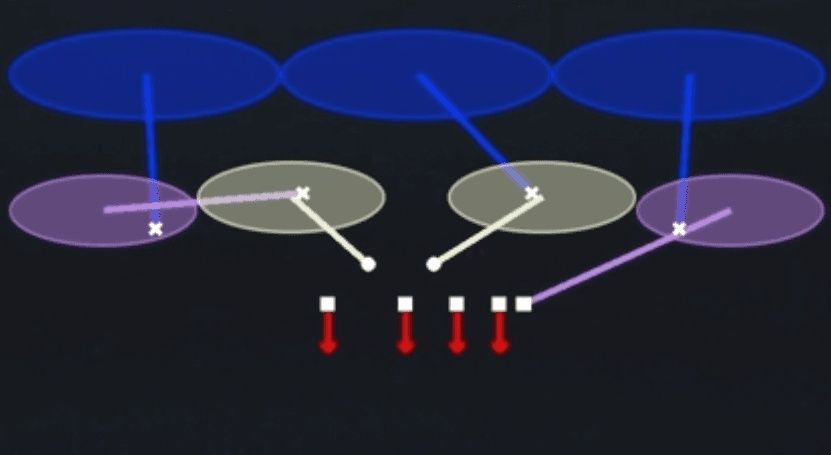
For years, a defense could survive by dropping defenders into landmarks, protecting grass, and rallying to the football. That model became increasingly fragile as college offenses embraced tempo, formations that stretched the field from sideline to sideline, and quarterbacks trained to attack leverage before the snap. The rise of the spread did not merely add more receivers. It changed the geometry of every defensive decision.
Space-and-pace offenses learned to put static underneath defenders in conflict. A linebacker dropping to a fixed hook zone could be pulled sideways by a shallow route, while a slot receiver climbed the seam behind him. A corner protecting the flat could be forced to widen by a bubble screen, opening an inside glance route. On the next snap, the same formation might produce a quarterback run, a screen, or four vertical releases. The defense was asked to defend the entire field without knowing which route would matter most.
Pattern matching became the answer because it combines zone structure with man-to-man accountability. Instead of defending empty grass, defenders read route stems and receiver distribution, then adjust their responsibilities as the play develops. The evolution moved beyond foundational zone coverage principles toward rules that let defenders contest receivers aggressively without surrendering run-gap integrity.
The Blueprint of Nick Saban Rip Liz Cover 3 Match
Rip/Liz emerged from a practical problem that spread offenses exposed repeatedly: how can a defense defend four vertical routes while keeping enough bodies near the line of scrimmage to handle the run? Traditional Cover 3 offered a strong single-high structure and an extra defender in the box, but the seam could become a soft spot. If both slot receivers released vertically, the underneath defenders risked being stretched between the seam and the curl-flat area.
The Rip/Liz solution assigns the defense a set of route-match rules rather than simple drop landmarks. The terminology identifies which safety is down and how the coverage adjusts to the formation and field position. Corners typically press or bail with outside leverage, protecting the deep outside third. The overhang defender, often a nickel or safety, is responsible for the seam and can convert from zone to man when the slot receiver threatens vertically. In many teaching systems, that conversion occurs once the number two receiver pushes beyond the underneath zone, often around five yards and continuing vertically.
The key is not a memorized yardage number. It is the defender”s recognition of the route stem, leverage, and available help. If number two runs through the seam, the overhang carries him. If number two breaks inside or underneath, the defender can communicate “Under” and return to the zone structure. That flexibility prevents the offense from winning simply by forcing a defender to choose between a deep seam and a flat route.
| Coverage feature | Traditional Cover 3 spot drop | Rip/Liz Cover 3 match |
|---|---|---|
| Slot vertical | May enter a seam void between zones | Overhang converts and carries the vertical threat |
| Corner technique | Protects a deep third landmark | Uses leverage and matches the outside receiver”s route |
| Box structure | Can vary depending on the call | Designed to preserve an extra run defender |
| Underneath routes | Defenders defend space first | Defenders pass routes according to distribution and release |
The boundary corner carries a major burden because the coverage may leave him isolated against an outside receiver. He must understand the divider, the imaginary line that determines where middle-of-field help exists, and maintain the correct leverage relative to that help. The middle safety cannot simply drift toward the quarterback. His pedal, angle, and eyes must preserve the integrity of the deep middle while responding to posts, seams, and crossers.
Suffocating the Mesh Concept and Horizontal Crossers
Mesh is a classic stress test because two receivers cross at roughly four to six yards, often with just enough separation to create traffic. Against pure man coverage, the natural rub routes can force defenders to bubble over the top, slow their pursuit, or collide with teammates. Against spot-drop zone, the crossers can occupy multiple defenders while a clearance route removes deep help. The quarterback then delivers a short completion with room to run.
Pattern matching gives defenders a better way to handle the crossing traffic. The goal is not for every defender to chase a receiver across the entire formation. Instead, defenders pass off routes when they reach a defined area, maintain leverage on the next threat, and communicate before the crosser enters the exchange point. A linebacker or nickel who waits too long creates trail separation. A defender who passes too early creates a window behind him.
- Banjo calls allow two defenders to exchange responsibilities based on releases rather than following one receiver blindly.
- Rat defenders sit inside the coverage structure and look for shallow crossers, cutting off throwing lanes without abandoning the quarterback.
- Bracket techniques place one defender underneath and another over the top of a dangerous crosser or mesh point.
- Safety cuts can attack deeper crossing routes before they reach open grass across the field.
- Immediate tackling prevents a completed mesh throw from becoming a drive-changing explosive play.
The best SEC defenses make mesh feel crowded before the ball arrives. Linebackers stay square, nickelbacks recognize the crossing relationship, and the rat defender refuses to drift out of the throwing lane. The coverage may look like man at the snap, but the post-snap behavior is coordinated zone football with man principles. That distinction matters against quarterbacks who are comfortable throwing into narrow windows.
Two-Read and Quarters Checks Against Modern Boot Action
Wide-zone play-action and bootlegs create a horizontal stretch first, then attack vertically with layered routes. The run action pulls linebackers toward the line, while the quarterback rolls toward a flat route, an intermediate over route, and a deeper vertical or comeback option. If the defense overreacts to the run, the bootleg quarterback can throw behind the flow. If defenders stay too deep, the offense can take the edge and gain easy yards.
Palms, also known as Two Read, gives split-field defenders a way to distribute those threats. The corner and safety read the outside receiver and the number two receiver together. If both release vertically, the corner can carry number one while the safety handles number two. If number two breaks quickly to the flat, the corner can drive the flat while the safety protects the remaining vertical route. The exact rules vary by system, but the central idea remains consistent: coverage reacts to route distribution rather than defending fixed landmarks.
The apex defender, aligned between the box and the slot, is often the trigger point. He must diagnose whether the slot is releasing to the flat, climbing on a wheel, blocking for the run, or crossing behind the linebackers. That defender cannot abandon the run fit, yet he must widen quickly enough to challenge the bootleg throw. Coordinators increasingly study how NFL defenses are evolving to stop the boot-action explosion, including tactics that prioritize preventing the quarterback keeper and explosive perimeter throw.
- Against a flat release, the apex defender widens while the safety preserves depth over the next route.
- Against a wheel, the defender must transition from outside leverage to vertical coverage without losing the receiver”s hip.
- Against a deep over, linebackers and safeties communicate the exchange before the route crosses the formation.
- Against a quarterback keeper, an edge defender may attack the quarterback while another defender scrapes to protect the run fit.
The defense is trying to defeat the conflict itself. A clean bootleg is dangerous because it makes one defender wrong by design. Pattern-match checks distribute the routes so that the flat, over route, quarterback, and deep shot are all accounted for without forcing a single player to cover two threats at once.
The Film Room Eye Discipline Checklist for DBs
Pattern matching is often described as a coverage call, but its success is determined by eye discipline. Defensive backs cannot stare at the quarterback and expect to process route combinations in time. They must read keys, recognize releases, and understand how the offensive formation changes the rules. Training resources that emphasize reading keys rather than simply watching the ball capture the central demand of this style of defense.
- Check pad level and the initial stance. At the snap, a defensive back”s posture reveals whether he is ready to press, bail, drive downhill, or carry a vertical route. High pads often create a false step, and a false step becomes separation against SEC speed.
- Build the triangle read. Track the quarterback, the uncovered interior lineman, and the release of the number two receiver. The offensive line can reveal run or pass intent, while the slot release tells the defender whether the coverage will remain zone-oriented or convert into a match.
- Recognize the stem break at eight to ten yards. Receivers often reveal the real route only after selling vertical acceleration. The defender must identify whether the stem is continuing, bending inside, breaking outside, or throttling down.
- Make the Under or Cut call early. Deep over routes and crossers must be passed off with conviction. A late call leaves two defenders attached to one route and exposes the next receiver in the progression.
The film-room test is simple but demanding: pause the play before the quarterback releases the ball and ask what each defender has seen. Has the corner confirmed the outside receiver”s vertical stem? Has the safety identified the crosser? Has the nickel communicated the flat exchange? If those answers are unclear, the defense is relying on athletic recovery rather than sound coverage mechanics.
That distinction separates an explosive defense from a vulnerable one. The fastest corner in the league still loses if his eyes are in the wrong place. The safety with average testing numbers can erase a route when his alignment, leverage, and communication are correct. Pattern matching rewards defenders who process the entire picture instead of reacting to the final movement of the football.
Mastering the Mental Edge on Saturdays
Pattern-match success is decided before the throw, and often before the snap. The defense must identify formation strength, communicate the coverage check, establish leverage, and understand who owns the first vertical threat. Once the routes declare, the response must be instantaneous. A hesitation of one step can turn a contested third down into a chunk gain, especially when the offense uses motion and tempo to prevent substitutions and extended communication.
That is why SEC recruiting staffs value football intelligence and spatial recognition alongside speed. Athletic ability gives a defensive back recovery potential, but anticipation keeps the receiver from gaining separation in the first place. On the next third-and-medium snap, watch the overhang defender, not just the quarterback. Track whether the nickel carries the seam, passes off the crosser, or triggers downhill on the flat. Then watch the safety”s depth and angle. Those small movements reveal whether the defense is merely sitting in zone or actively cracking the route tree before the ball arrives.